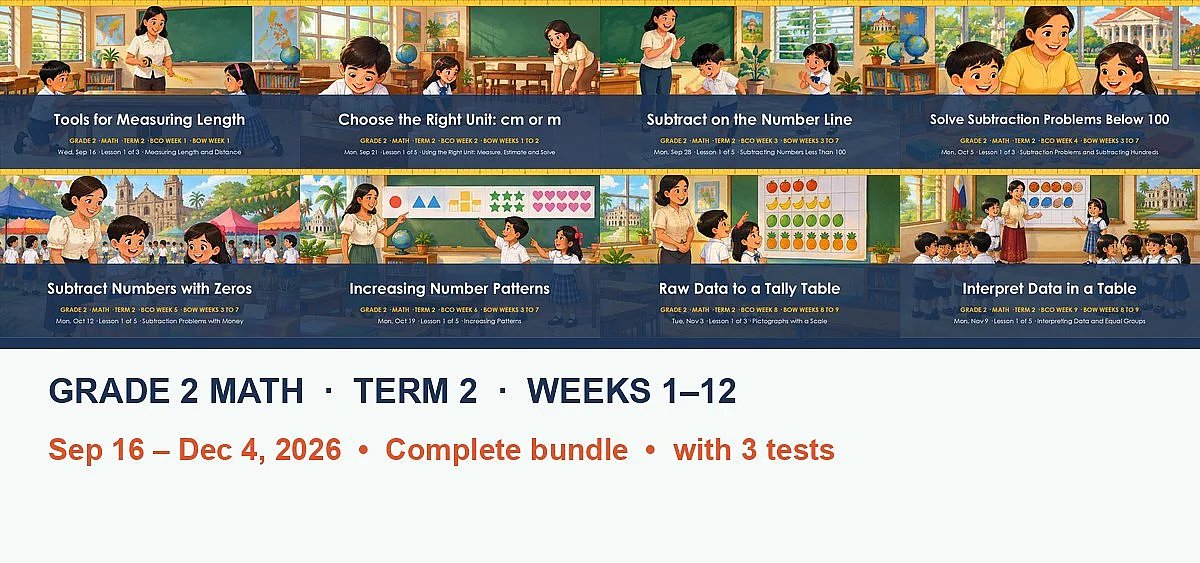
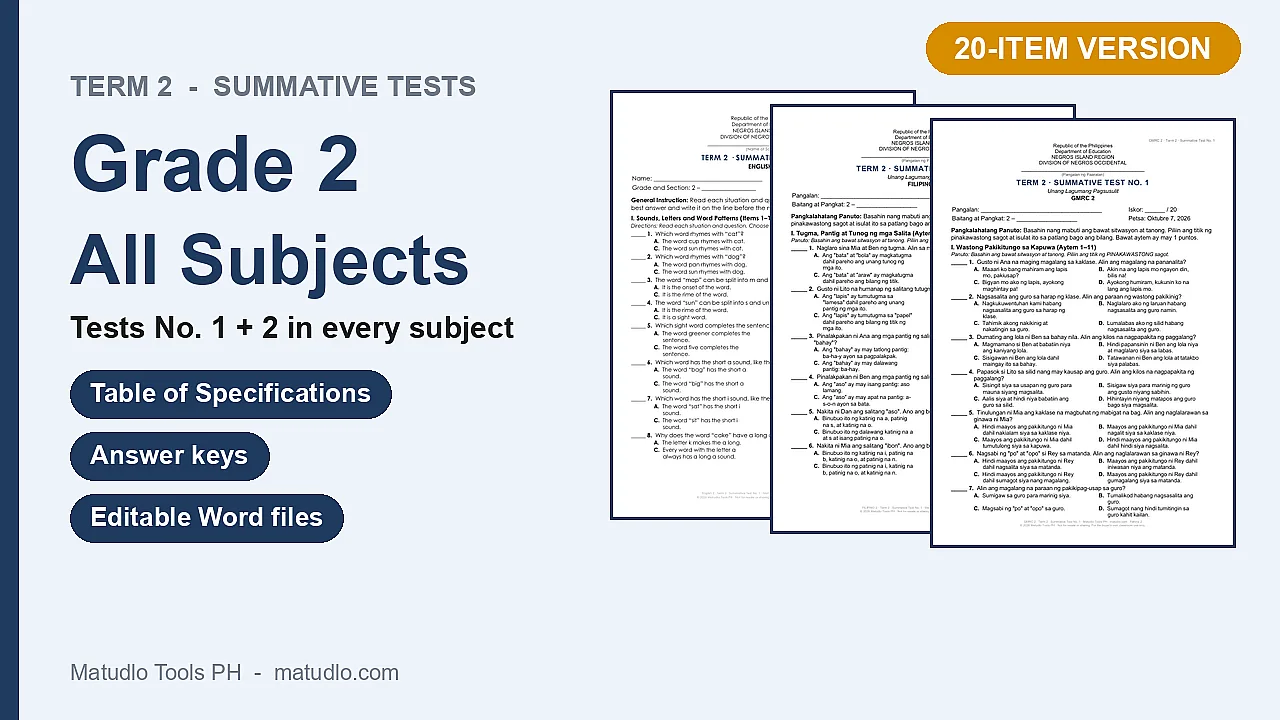
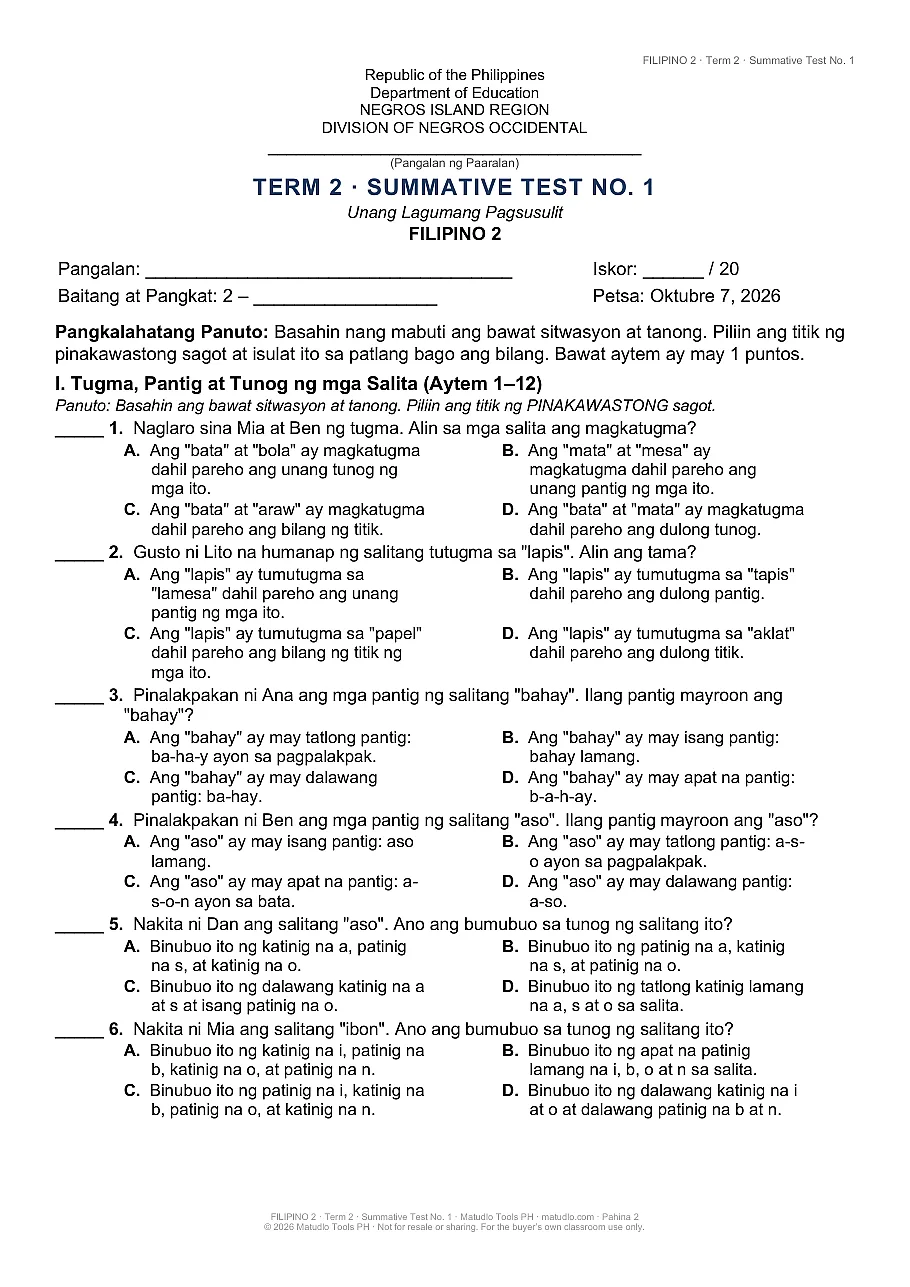
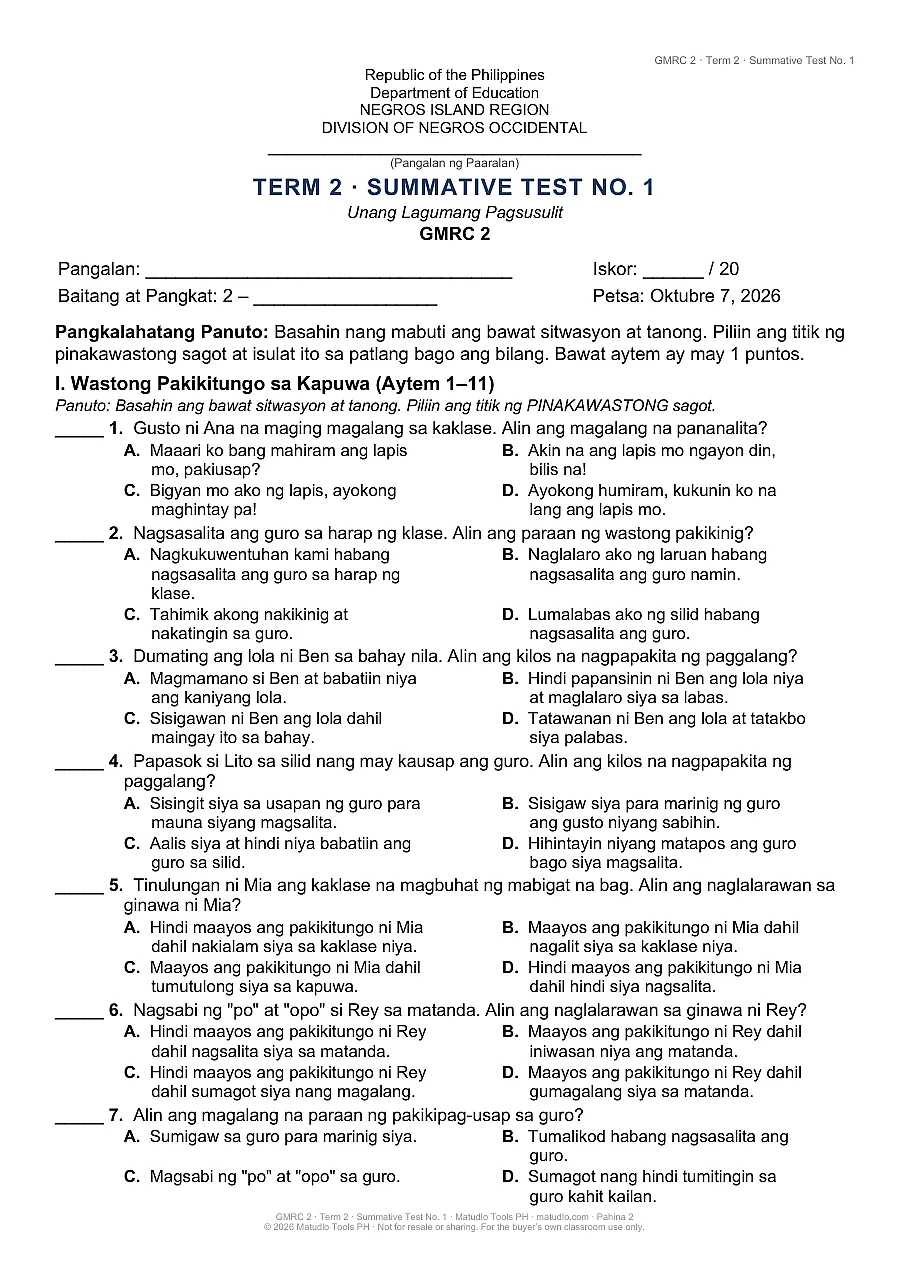
Grade 2 Term 2 Summative Tests – All Subjects, 20-Item Version (Test No. 1 and No. 2 in every subject)
WARNING: made for Negros Occidental (BCO-aligned). 20-item version: Grade 2 Term 2 Summative Test No. 1 and No. 2 for 5 subjects, with TOS, learning competencies and answer key, in editable Word. Includes a Simplified Version for struggling readers.
-
Free file updates When we improve this pack, you get the new version free and we email you. Download it again any time from My Account. Last updated Oct 28, 2026
-
Fix or refund If a file won’t open or doesn’t match the description, message us within 7 days — we fix it or refund you. Refund policy
-
Instant download Sent to your email and kept in My Account. Every file opens and edits in PowerPoint and Word.
-
Secure payment GCash, Maya or card, through PayMongo.
About This Product
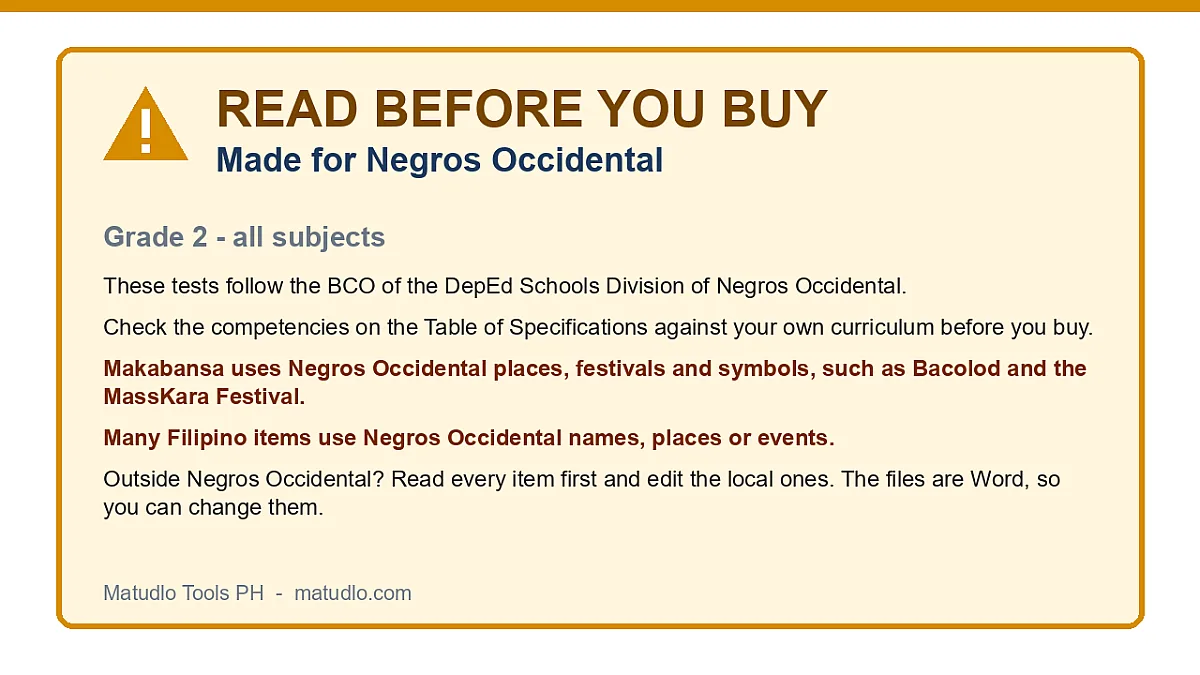
WARNING - Made for Negros Occidental. These tests follow the BCO (Budget Course Outlay) of the DepEd Schools Division of Negros Occidental, and the Table of Specifications is aligned to it. Check the competencies listed below, and on the Table of Specifications, against your own curriculum before you buy. Makabansa uses Negros Occidental places, festivals and symbols, such as Bacolod and the MassKara Festival. Many Filipino items use Negros Occidental names, places or events. Outside Negros Occidental? Read every item first and edit the local ones. The files are Word, so you can change them.
This is the 20-item version. The same tests are also sold as a shorter 15-item version: https://matudlo.com/product/grade-2-term-2-summative-tests-all-subjects-bundle. Buy one version, not both.
All Grade 2 Term 2 summative tests in one pack: Summative Test No. 1 and No. 2 for English, Filipino, GMRC, Makabansa and Mathematics, 20 items each. This pack has the two summative tests for each subject and does not include the Term 2 Examinations.
- Each test has 20 items with four choices (A–D), a Table of Specifications (one row per BCO objective, with its learning competency), the test paper and an answer key.
- Simplified Version included: a separate set of both tests for struggling readers, with shorter, simpler wording and three choices (A-C) instead of four. It has the same objectives, items and Table of Specifications, in a “Simplified Version” folder inside the ZIP.
- Every item tests Remember, Understand or Apply only (lower-order skills), because these are young learners. The 20 items are split 7 Remember, 7 Understand and 6 Apply.
- Editable Word files, ready to print. No PDFs.
What the tests cover
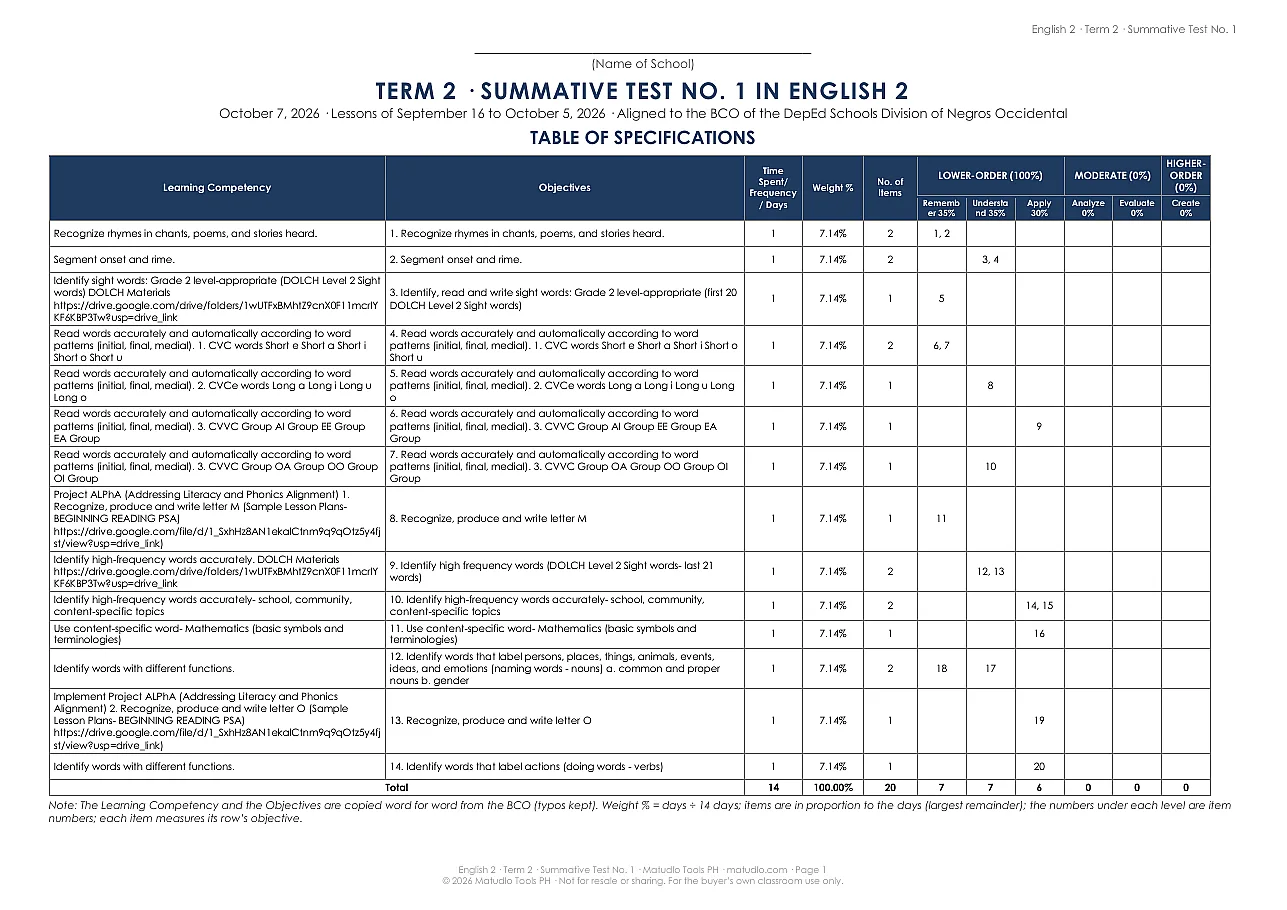
The objective for every test item is listed on page 1 of each test, next to its learning competency. The competencies, word for word from the BCO:
English
Test No. 1: Sounds, Word Patterns and Kinds of Words (October 7, 2026)
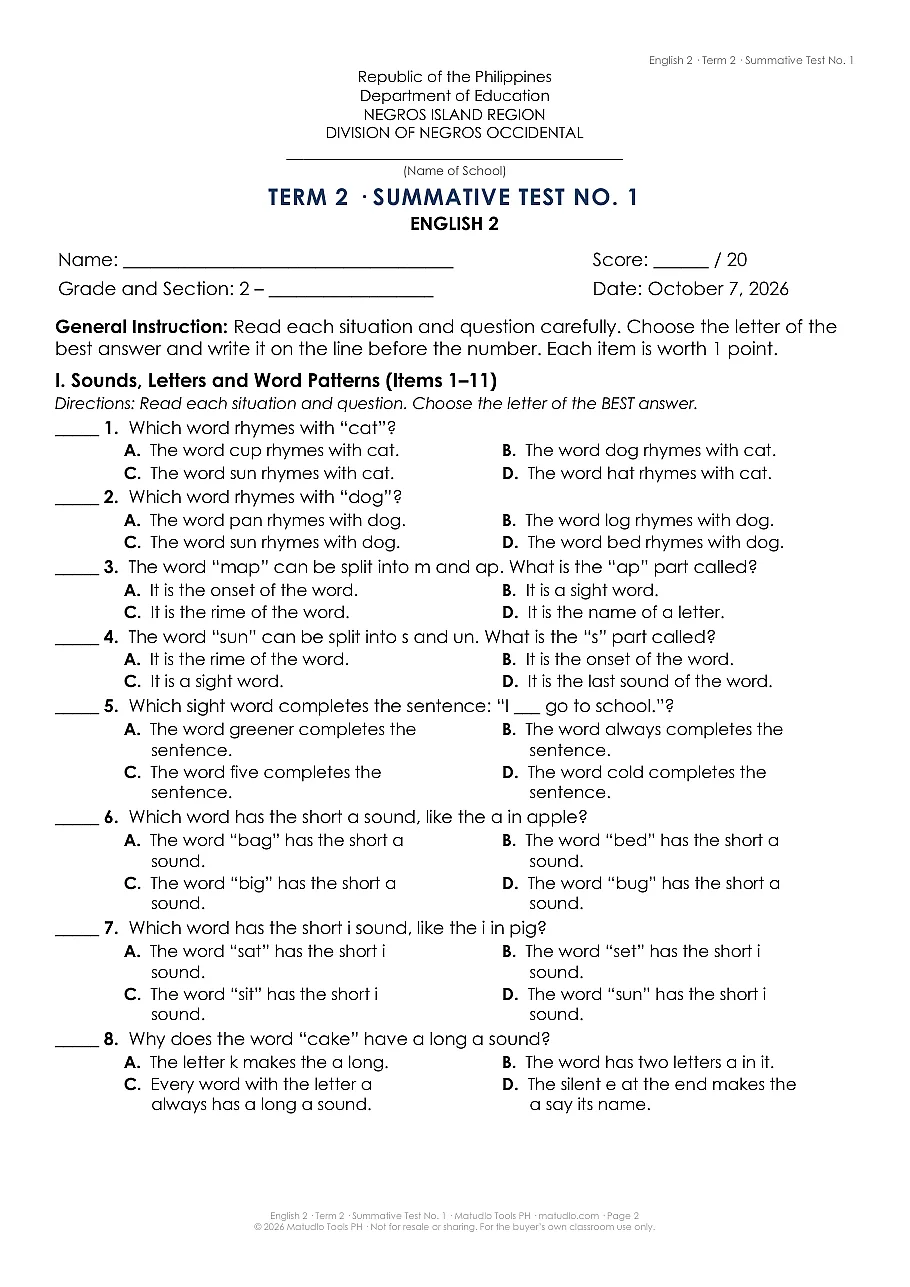
- Recognize rhymes in chants, poems, and stories heard.
- Segment onset and rime.
- Identify sight words: Grade 2 level-appropriate (DOLCH Level 2 Sight words) DOLCH Materials
- Read words accurately and automatically according to word patterns (initial, final, medial). 1. CVC words Short e Short a Short i Short o Short u
- Read words accurately and automatically according to word patterns (initial, final, medial). 2. CVCe words Long a Long i Long u Long o
- Read words accurately and automatically according to word patterns (initial, final, medial). 3. CVVC Group AI Group EE Group EA Group
- Read words accurately and automatically according to word patterns (initial, final, medial). 3. CVVC Group OA Group OO Group OI Group
- Project ALPhA (Addressing Literacy and Phonics Alignment) 1. Recognize, produce and write letter M (Sample Lesson Plans- BEGINNING READING PSA)
- Identify high-frequency words accurately. DOLCH Materials
- Identify high-frequency words accurately- school, community, content-specific topics
- Use content-specific word- Mathematics (basic symbols and terminologies)
- Identify words with different functions.
- Implement Project ALPhA (Addressing Literacy and Phonics Alignment) 2. Recognize, produce and write letter O (Sample Lesson Plans- BEGINNING READING PSA)
Test No. 2: Describing Words, Sentences and Stories (October 29, 2026)
- Identify words with different functions.
- Implement Project ALPhA (Addressing Literacy and Phonics Alignment) 2. Recognize, produce and write letter P (Sample Lesson Plans- BEGINNING READING PSA)
- Read and write words correctly for meaning (based on word patterns).
- Identify roots of high frequency words (nouns, verbs, and adjectives).
- Identify sentences and non-sentences.
- Implement Project ALPhA (Addressing Literacy and Phonics Alignment) 2. Recognize, produce and write letter T (Sample Lesson Plans- BEGINNING READING PSA)
- Use simple sentences to express ideas about oneself, family, school, community, physical environment, regional themes, national themes, and content-specific and use correct capitalization and punctuation for simple sentences. 1. telling sentences (declarative) 2. asking sentences (interrogative) 3. commanding and requesting sentences (imperative) 4. exclamatory sentences
- Sequence words to represent meaning in simple sentences and identify the parts of simple sentences: (who/what, what are they doing, when/where/how). 1. telling sentences (declarative) 2. asking sentences (interrogative) 3. commanding and requesting sentences (imperative) 4. exclamatory sentences and read grade level sentences with appropriate speed, accuracy, and expression, proper intonation (pitch, juncture, rhythm)
- Identify discourse markers for a given text type. 1. time order and procedural 2. description
- Comprehend stories
- Implement Project ALPhA (Addressing Literacy and Phonics Alignment) 2. Recognize, produce and write letter S (Sample Lesson Plans- BEGINNING READING PSA)
Filipino
Test No. 1: Tugma, Pantig, Salitang Madalas Gamitin at Pangngalan (Oktubre 7, 2026)
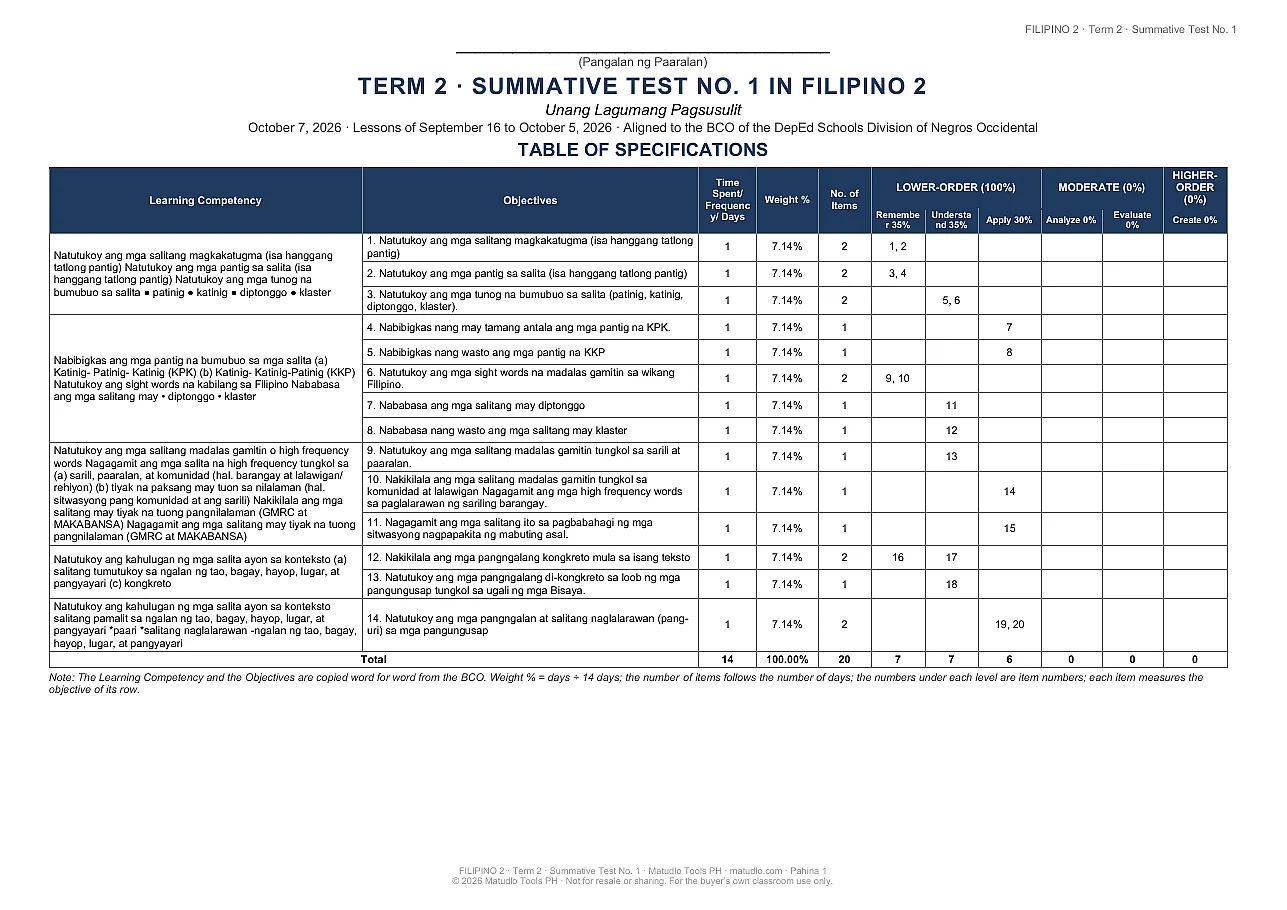
- Natutukoy ang mga salitang magkakatugma (isa hanggang tatlong pantig) Natutukoy ang mga pantig sa salita (isa hanggang tatlong pantig) Natutukoy ang mga tunog na bumubuo sa salita ● patinig ● katinig ● diptonggo ● klaster
- Nabibigkas ang mga pantig na bumubuo sa mga salita (a) Katinig- Patinig- Katinig (KPK) (b) Katinig- Katinig-Patinig (KKP) Natutukoy ang sight words na kabilang sa Filipino Nababasa ang mga salitang may • diptonggo • klaster
- Natutukoy ang mga salitang madalas gamitin o high frequency words Nagagamit ang mga salita na high frequency tungkol sa (a) sarili, paaralan, at komunidad (hal. barangay at lalawigan/ rehiyon) (b) tiyak na paksang may tuon sa nilalaman (hal. sitwasyong pang komunidad at ang sarili) Nakikilala ang mga salitang may tiyak na tuong pangnilalaman (GMRC at MAKABANSA) Nagagamit ang mga salitang may tiyak na tuong pangnilalaman (GMRC at MAKABANSA)
- Natutukoy ang kahulugan ng mga salita ayon sa konteksto (a) salitang tumutukoy sa ngalan ng tao, bagay, hayop, lugar, at pangyayari (c) kongkreto
- Natutukoy ang kahulugan ng mga salita ayon sa konteksto salitang pamalit sa ngalan ng tao, bagay, hayop, lugar, at pangyayari *paari *salitang naglalarawan -ngalan ng tao, bagay, hayop, lugar, at pangyayari
Test No. 2: Pandiwa, Pantukoy, Pangungusap at Wastong Pagsulat (Oktubre 29, 2026)
- Natutukoy ang kahulugan ng mga salita ayon sa konteksto salitang kilos salitang pangkayarian
- Natutukoy ang kahulugan ng mga salita ayon sa konteksto (e) salitang pantukoy sa ngalan ng tao, lugar, hayop, bagay at pangyayari (ang, ang mga, si, sina) (f) salitang pang- ugnay (at, o) Nakasusulat ng mga letra, salita at pangungusap sa paraang kabit-kabit gamit ang mga natutuhang salita
- Natutukoy ang pangungusap at di-pangungusap Natutukoy ang payak na pangungusap batay sa gamit (a) paturol/pasalaysay (b) patanong (c) pakiusap/pautos Nagagamit ang malaki at maliit na letra at bantas sa payak na pangungusap na: (a) paturol/pasalaysay (b) patanong (c) pakiusap/pautos
- Nagagamit ang malaki at maliit na letra sa pagbuo ng payak na pangungusap Nagagamit nang may wastong intonasyon, diin at hinto ang mga nakagawiang pagbati, ekspresyon at angkop na pananalita sa iba’t ibang pansarili, pampaaralan at pangkomunidad na sitwasyon (a) pagpapakilala sa sarili (b) pangungumusta (c) pasasalamat
GMRC
Test No. 1: Pakikipagkapuwa at Pampublikong Pasilidad (Oktubre 7, 2026)
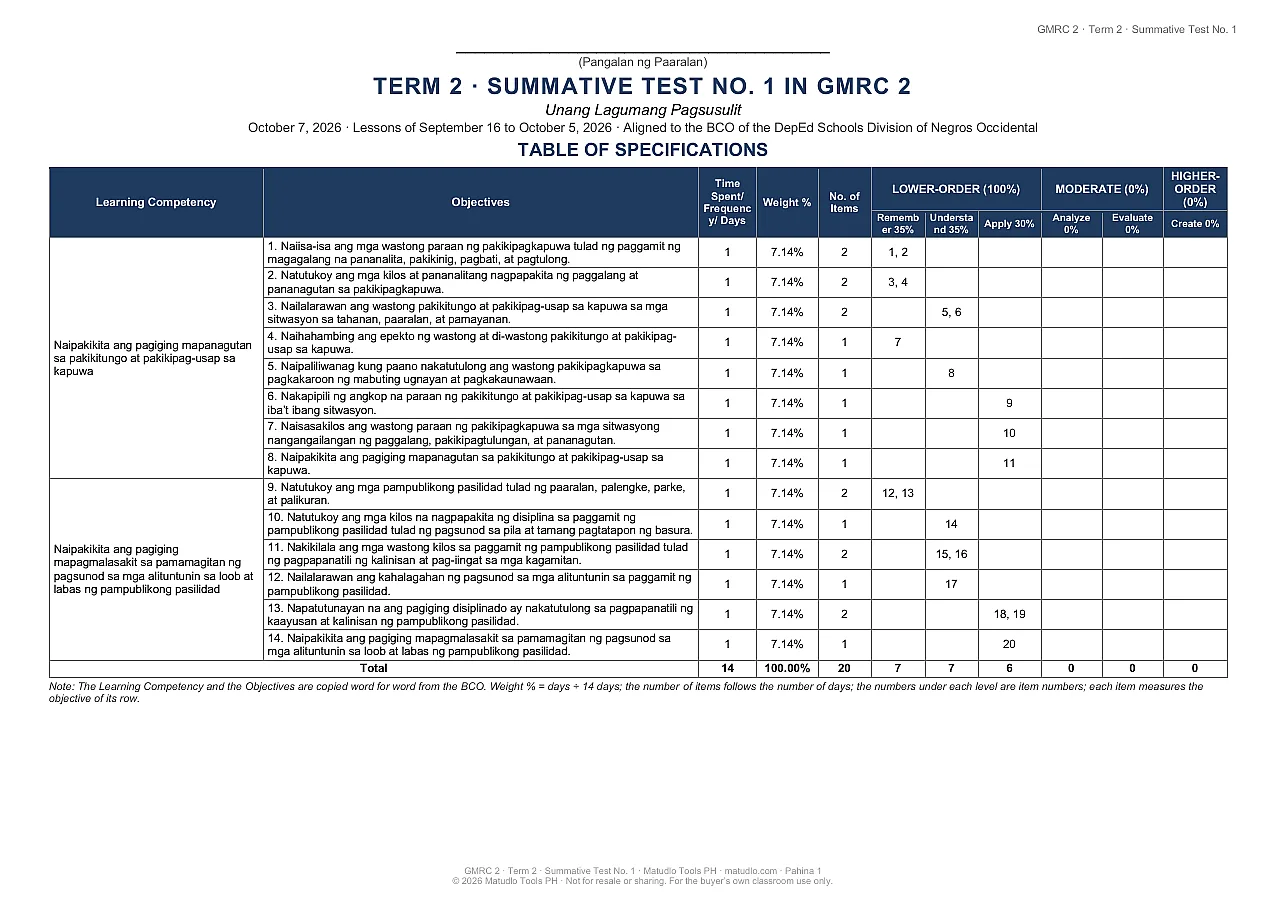
- Naipakikita ang pagiging mapanagutan sa pakikitungo at pakikipag-usap sa kapuwa
- Naipakikita ang pagiging mapagmalasakit sa pamamagitan ng pagsunod sa mga alituntunin sa loob at labas ng pampublikong pasilidad
Test No. 2: Pagpapasensiya, Katapatan, Pananampalataya at Kalinisan (Oktubre 29, 2026)
- Naipakikita ang pagiging mapagpasensiya sa pamamagitan ng paggamit ng mga magagalang na pananalita at wastong pagkilos
- Naipakikita ang katapatan sa pamamagitan ng pagsasabi ng katotohanan sa iba't ibang situwasyon
- Naipakikita ang pagiging masunurin sa pamamagitan ng pakikilahok sa mga gawaing panrelihiyon o paniniwala ng pamilya
- Naipakikita ang pagkamaayos sa pamamagitan ng pagsunod sa mga alituntunin at tagubilin ng pamilya sa pagpapanatili ng kalinisan
Makabansa
Test No. 1: Kultura sa Tahanan, Paaralan at Komunidad (Oktubre 7, 2026)
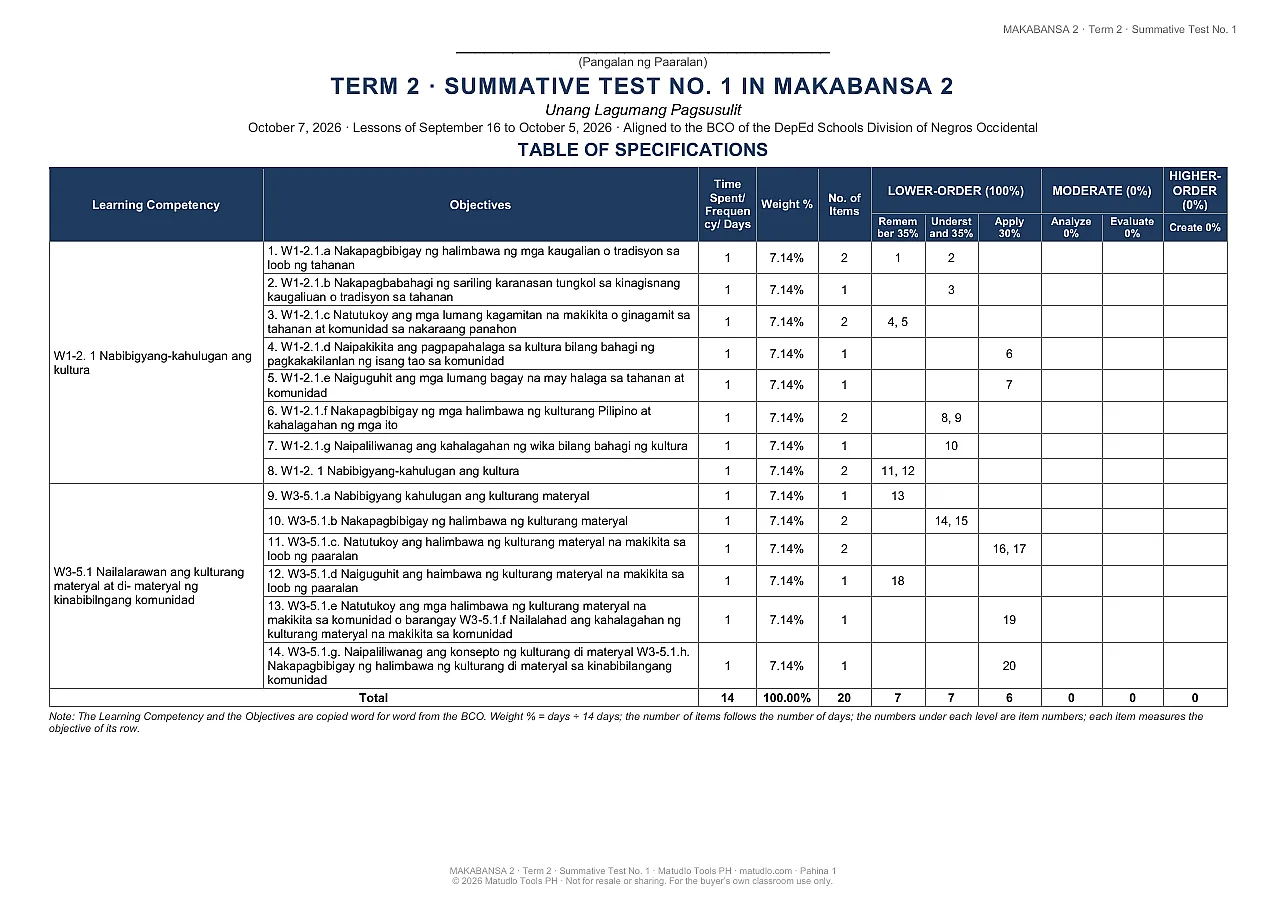
- W1-2. 1 Nabibigyang-kahulugan ang kultura
- W3-5.1 Nailalarawan ang kulturang materyal at di- materyal ng kinabibilngang komunidad
Test No. 2: Laro, Tradisyon, Pagkain, Kuwentong-bayan at Pagkakakilanlan (Oktubre 29, 2026)
- W3-5.1 Nailalarawan ang kulturang materyal at di- materyal ng kinabibilngang komunidad
- W6-8.1 Naipaliliwanag ang kaugnayan ng kultura sa paghubog ng pagkakakilanlan
Mathematics
Test No. 1: Length, Distance and Subtraction up to 100 (October 7, 2026)
- Measure and compare lengths of objects, in meters (m) or centimeters (cm), and distance in meters, using appropriate measuring tools.
- 1. Identify and use the appropriate unit (m or cm) to measure the length of an object and the distance between two locations. 2. Estimate length using meters or centimeters, and distance using meters. 3. Solve problems involving length and distance.
- 1. Illustrate subtraction of 2-digit by 1-digit on the number line and as an inverse of addition. 2. Subtract numbers where both numbers are less than 100 with regrouping: a. 2-digit minus 1-digit numbers
- Subtract numbers where both numbers are less than 100 with regrouping: b. 2-digit minus 2-digit numbers
- Solve problems (given orally or in pictures) involving subtraction where both numbers are less than 100, with and without regrouping.
Test No. 2: Subtraction up to 1 000 and Patterns (October 29, 2026)
- Subtract numbers, where both numbers are less than 1000, with and without regrouping.
- Solve 1- and 2-step problems involving subtraction where both numbers are less than 1000 (including problems involving money), with and without regrouping.
- Determine the next term/s in increasing or decreasing patterns, e.g., numbers, letters and rhythmic properties, visual elements in arts, and repetitions.
- Create increasing or decreasing patterns.
Customer Reviews
No reviews yet — be the first to share your experience!
Questions & Answers
Frequently Bought Together
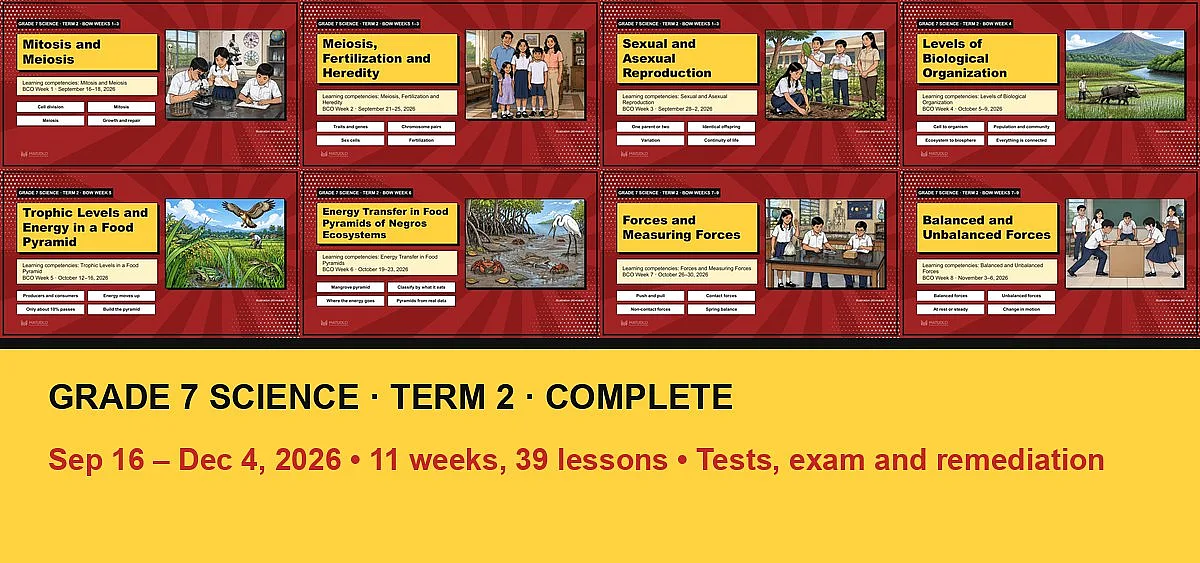
Grade 7 Science Term 2: Complete Bundle (Sep 16 – Dec 4, all 11 weeks + tests, exam and remediation)
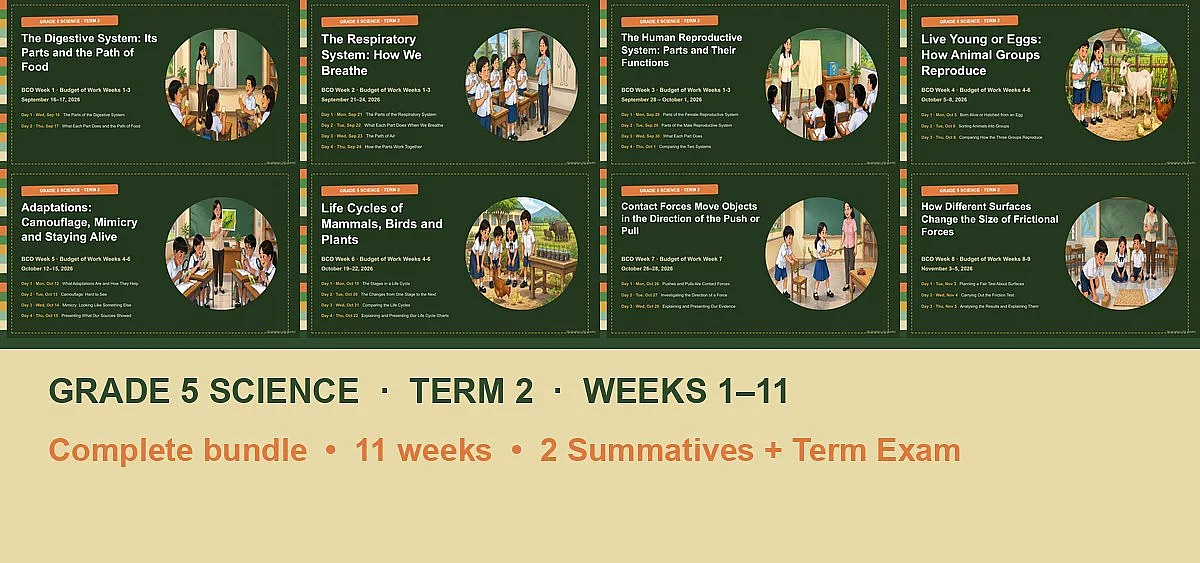
Grade 5 Science Term 2: Complete Bundle (Weeks 1–11, Sep 16 – Nov 26)
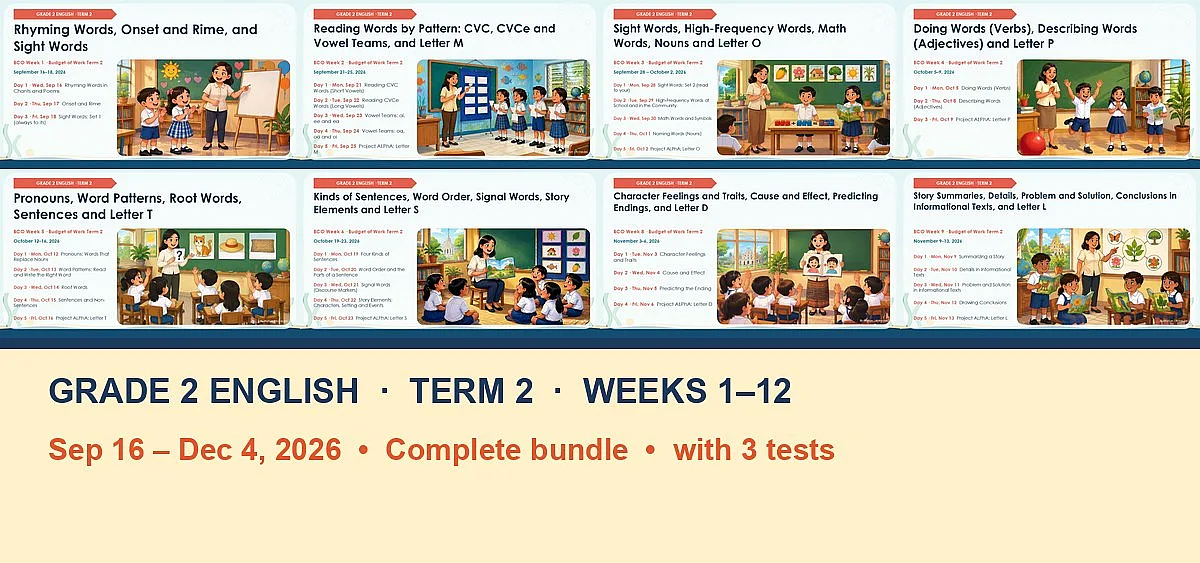
English 2 (Grade 2) Term 2: Complete Bundle (BCO Weeks 1–12, Sep 16 – Dec 4)