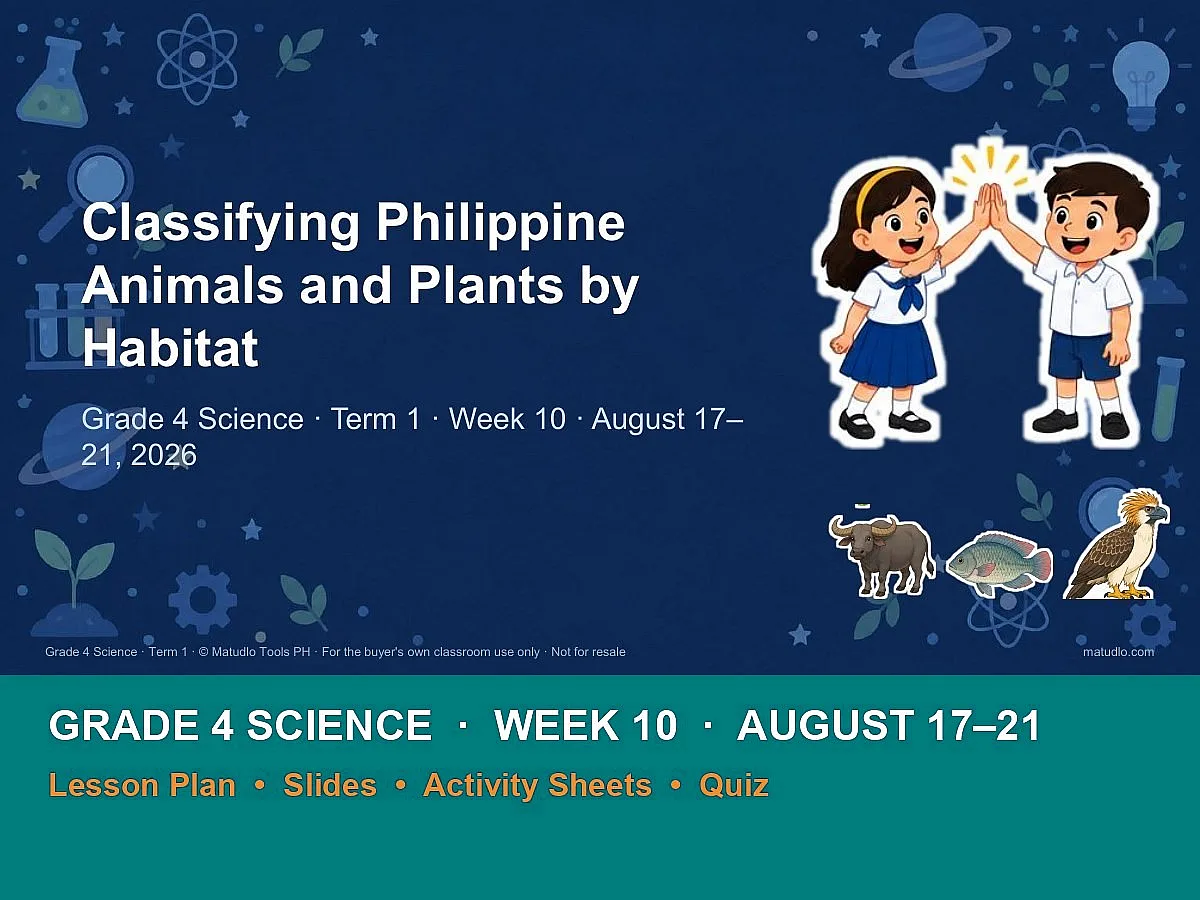
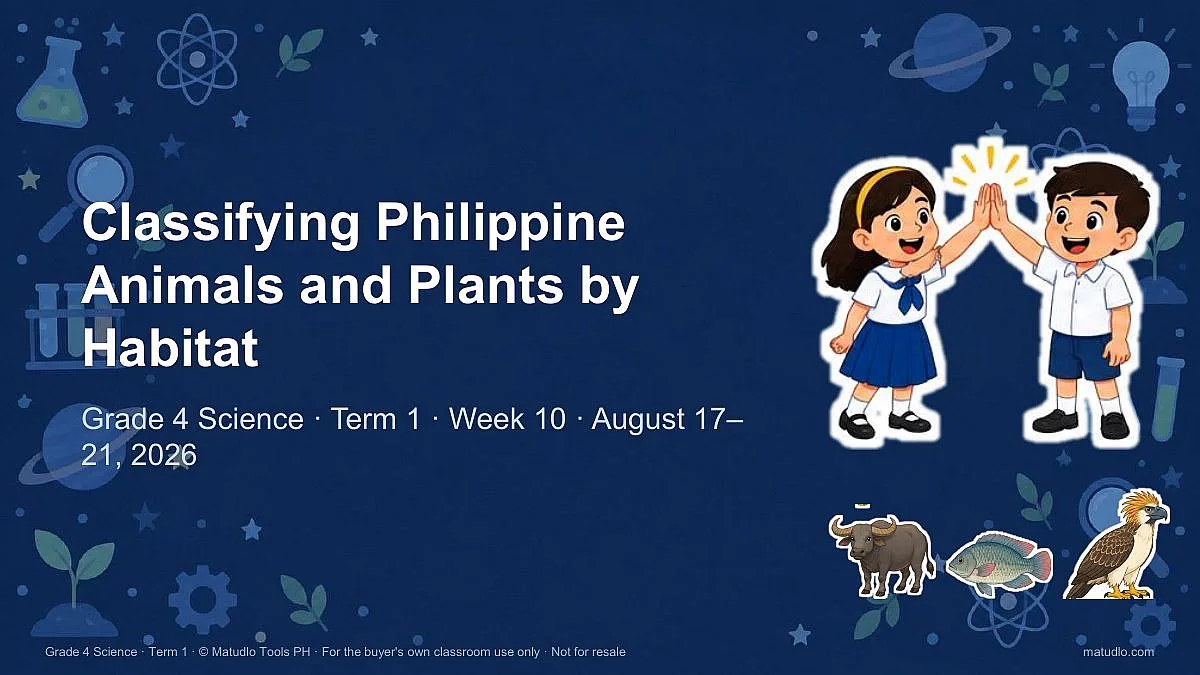
Grade 4 Science Term 1 Week 10 (August 17–21): Classifying Philippine Animals and Plants by Habitat – Weekly Lesson Plan Pack
Grade 4 Science, Term 1, Week 10 (August 17–21, 2026): lesson plan, designed slides, activity sheets and quiz on Classifying Philippine Animals and Plants by Habitat. Aligned to the DepEd Negros Occidental BCO.
-
Free file updates When we improve this pack, you get the new version free and we email you. Download it again any time from My Account.
-
Fix or refund If a file won’t open or doesn’t match the description, message us within 7 days — we fix it or refund you. Refund policy
-
Instant download Sent to your email and kept in My Account. Every file opens and edits in PowerPoint and Word.
-
Secure payment GCash, Maya or card, through PayMongo.
About This Product
A complete, ready-to-teach week of Grade 4 Science for August 17–21, 2026, aligned to the Budget Course Outlay (BCO) of the DepEd Schools Division of Negros Occidental. Lesson plan, designed PowerPoint slides, activity sheets and a weekly quiz, all pre-dated for the week.
Files in this pack (6 items)
- 1 LESSON PLAN: Word document (.docx), 6 pages
- 2 SLIDES: PowerPoint presentation (.pptx), 71 slides
- 3 ACTIVITY SHEETS: Word document (.docx), 9 pages
- 4 WEEKLY QUIZ: Word document (.docx), 2 pages
- 0 READ FIRST (Terms of Use): Word document (.docx), 1 page
- Cutouts (bonus folder): transparent PNG stickers (students and teacher, lab tools, nature, body parts, icons and a thumbs up and down set) to drag onto your own slides and worksheets.
What each file is for
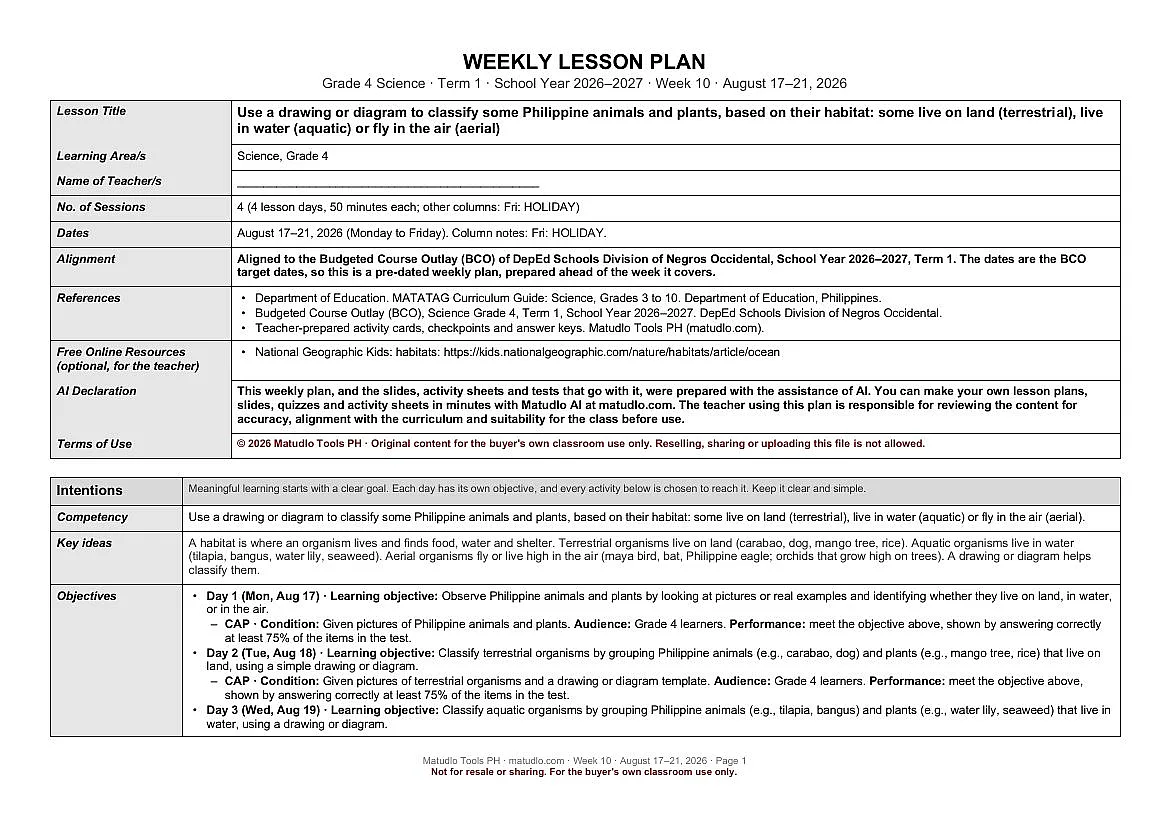
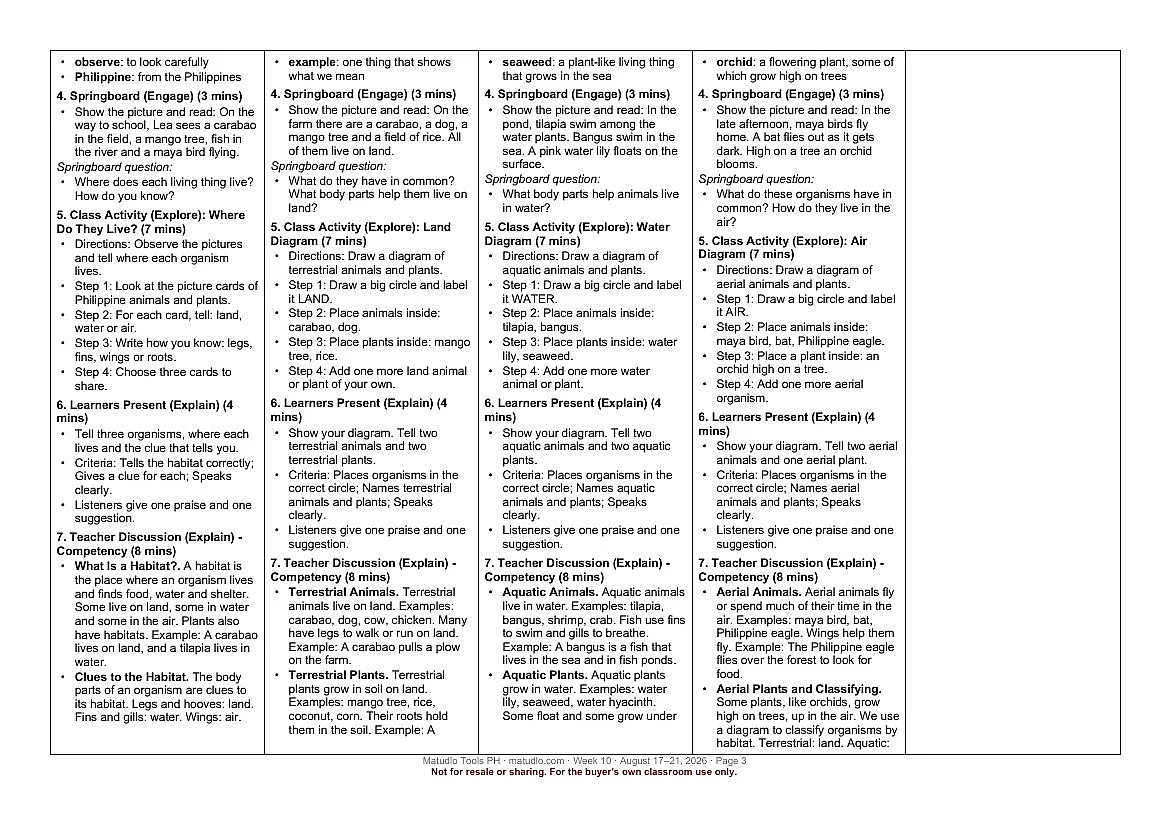
- 1 Lesson Plan (Word, editable): the weekly plan with all five columns of the week, the learning competency and objectives quoted verbatim, CAP objectives, a minute-by-minute daily flow, guided questions for the generalization, an application task and an aligned assessment.
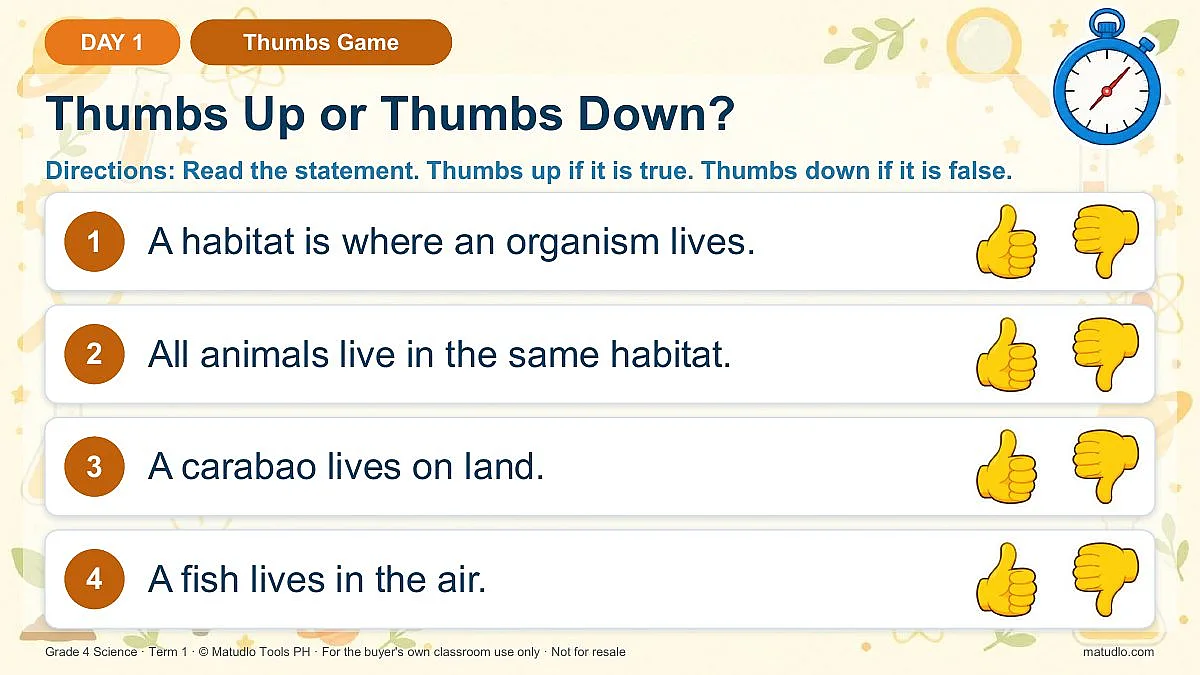
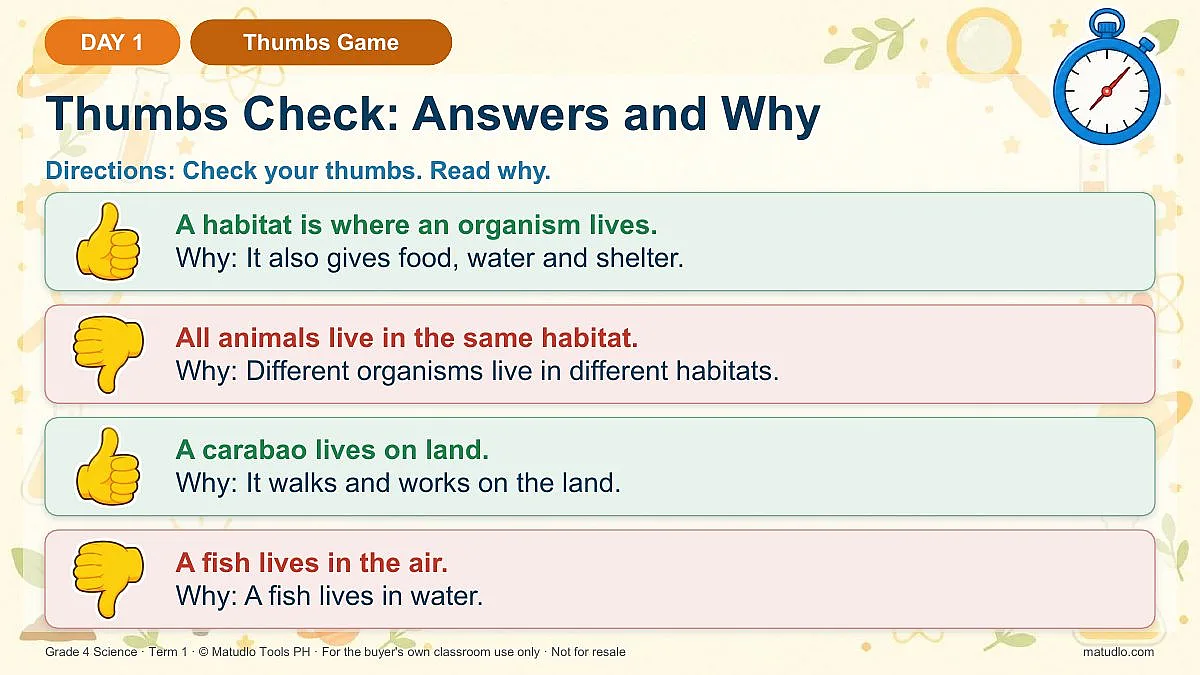
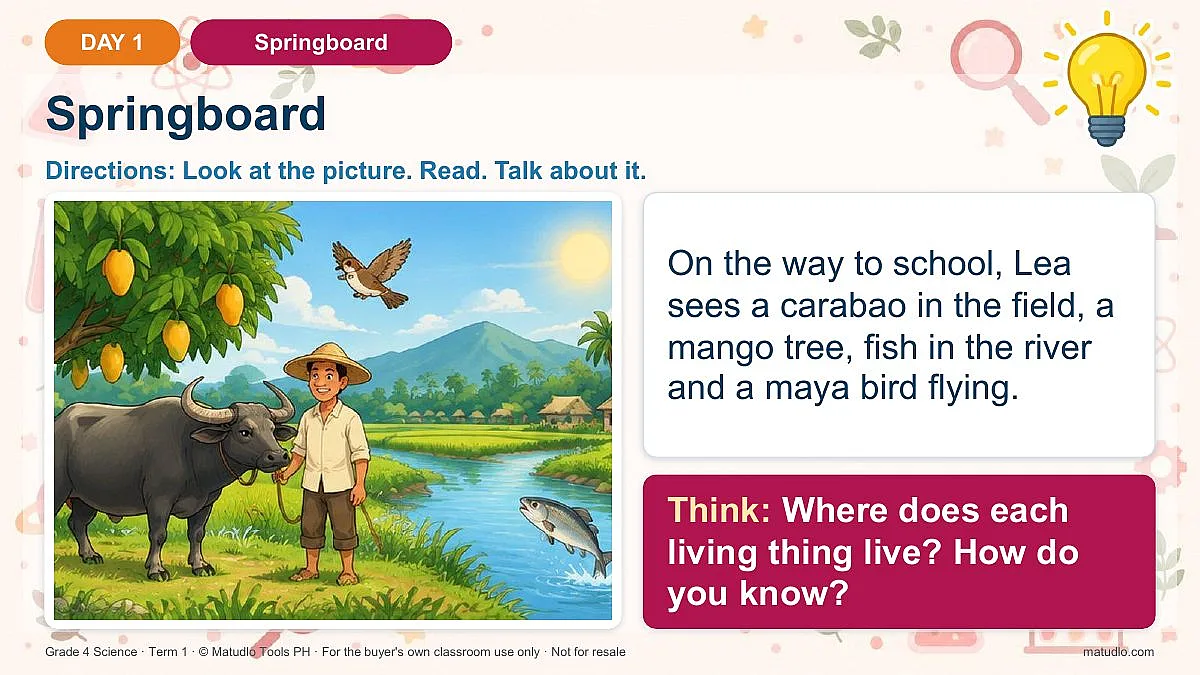
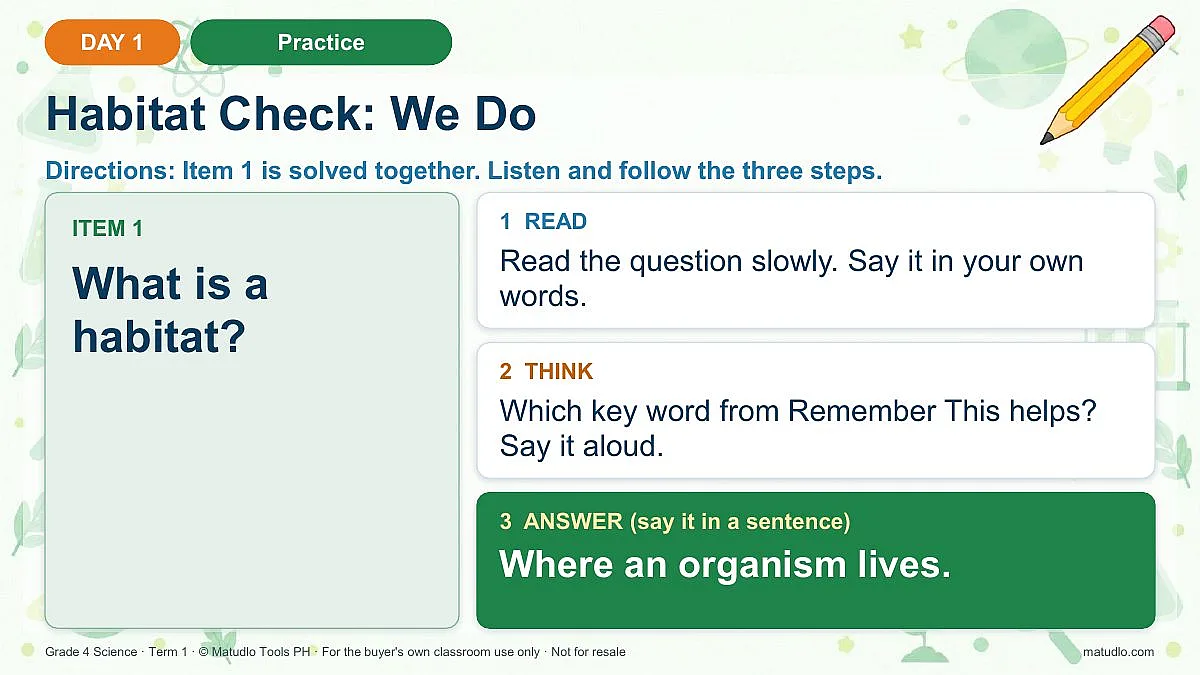
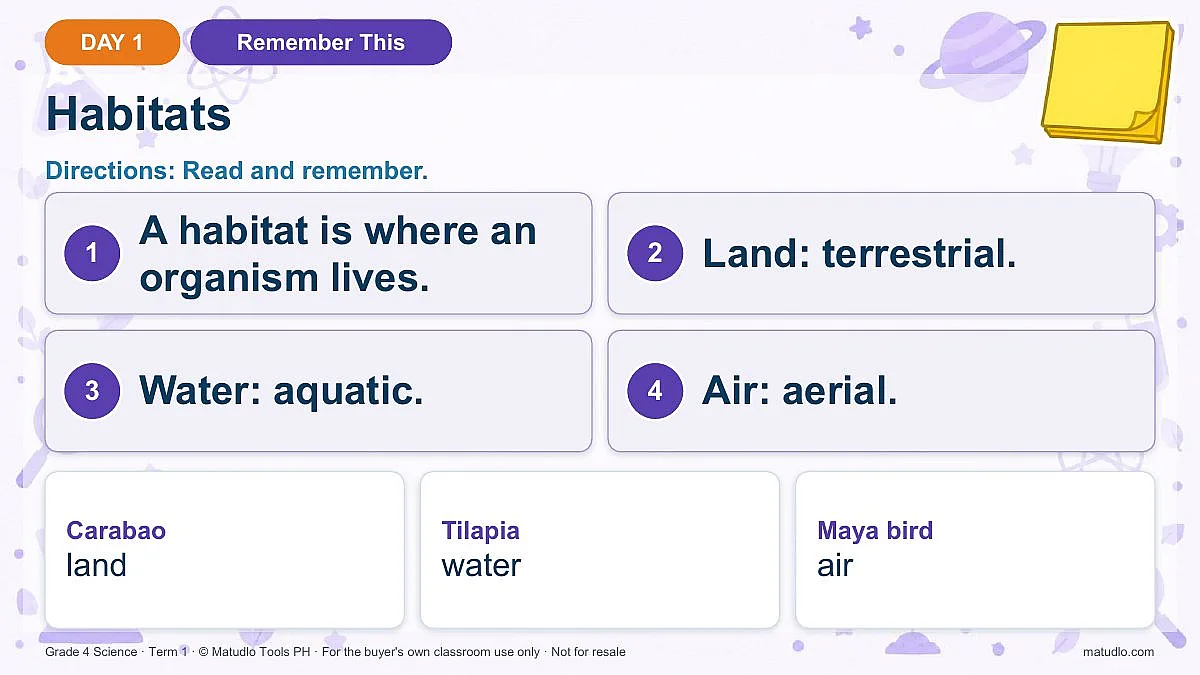
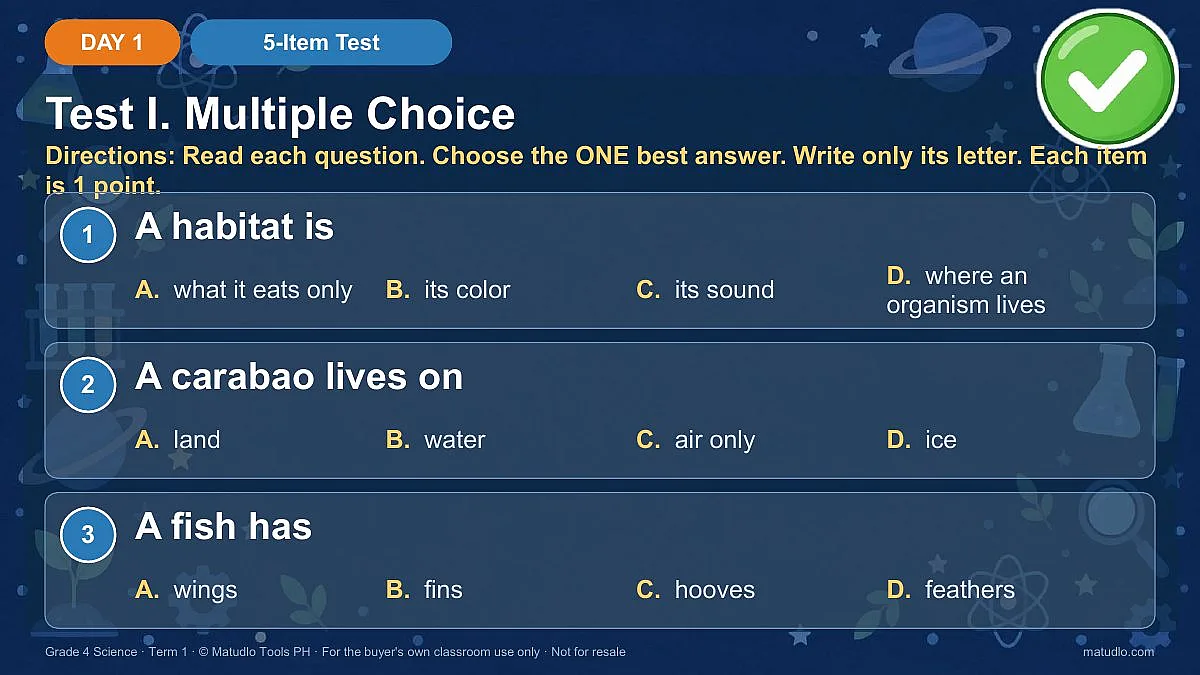
- 2 Slides (PowerPoint): 71 professionally designed slides with themed backgrounds and friendly cut-out characters. Every lesson day follows one clear flow: Review, Thumbs Up or Thumbs Down game, Difficult Words, Springboard, Class Activity, Learners Present, Teacher Discussion, Guided Practice (We Do, You Do), Generalization (guided questions), Remember This, Application and a 5-Item Test. Diagrams of the body systems and plant parts are drawn exactly, every drill is a Thumbs Up or Thumbs Down game that explains why, and every slide is fully editable.
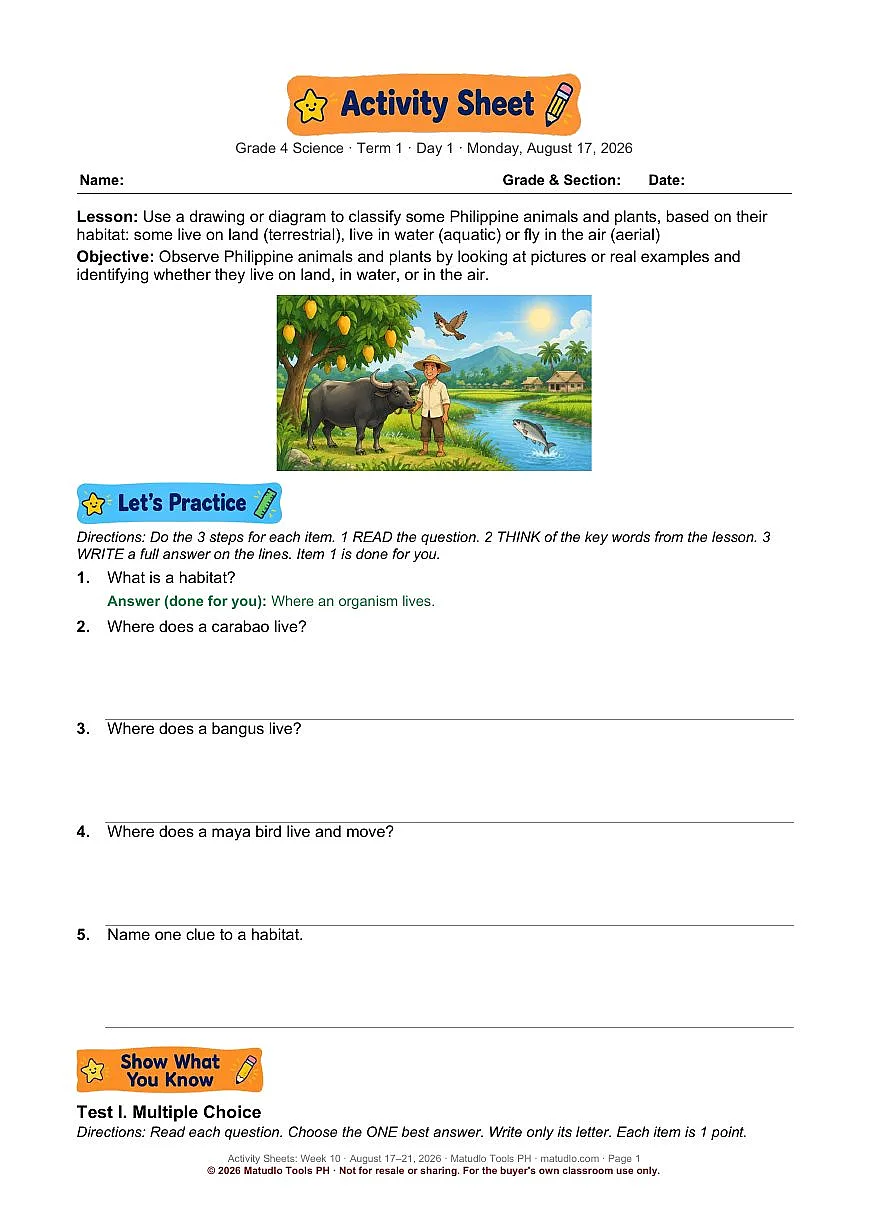
- 3 Activity Sheets (Word, print-ready): one sheet per lesson day with a picture, guided practice, the 5-item test, an application task and a teacher answer key.
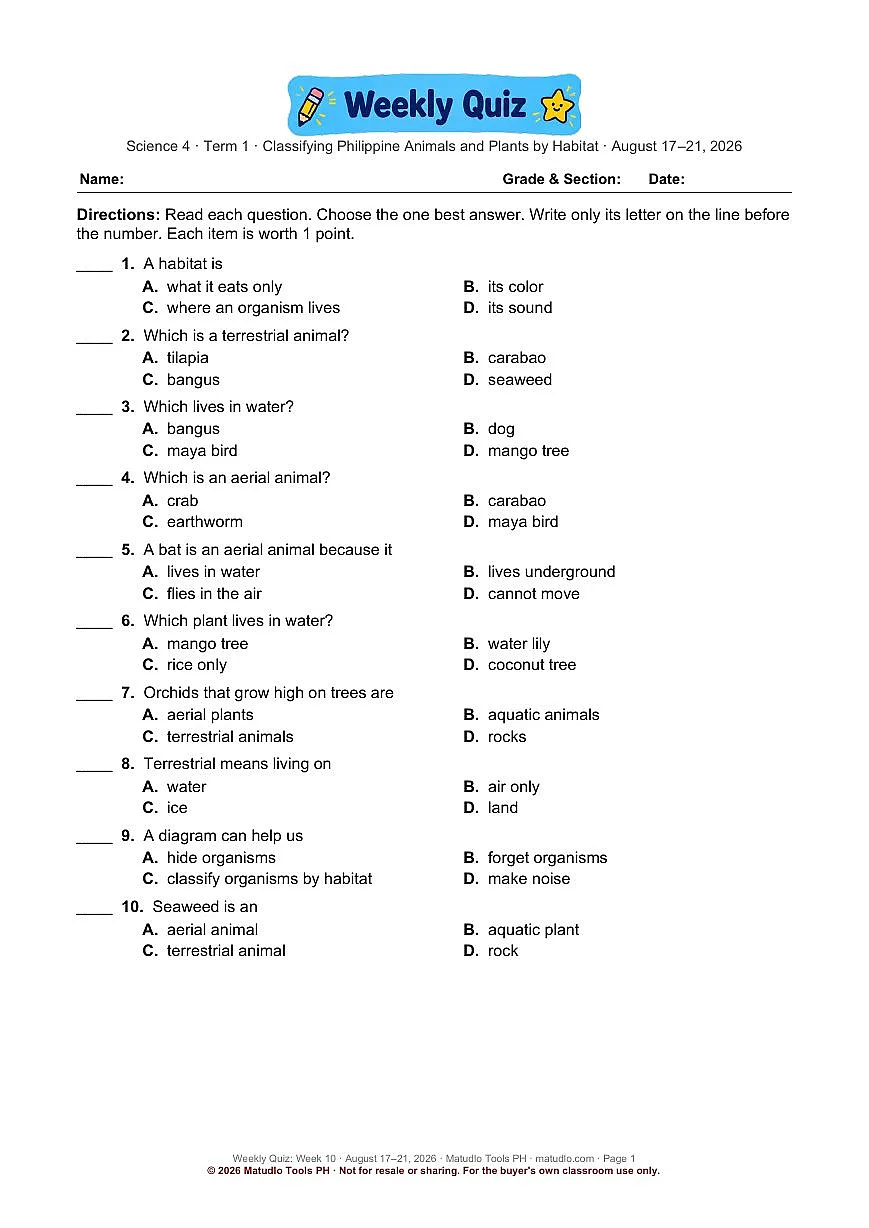
- 4 Weekly Quiz (Word): a 10-item multiple-choice Weekly Quiz with answer key.
- 0 READ FIRST (Word): the terms of use.
- Cutouts (bonus folder): transparent PNG stickers (students and teacher, lab tools, nature, body parts, icons and a thumbs up and down set) to drag onto your own slides and worksheets.
Learning competency
Use a drawing or diagram to classify some Philippine animals and plants, based on their habitat: some live on land (terrestrial), live in water (aquatic) or fly in the air (aerial).
Daily learning objectives
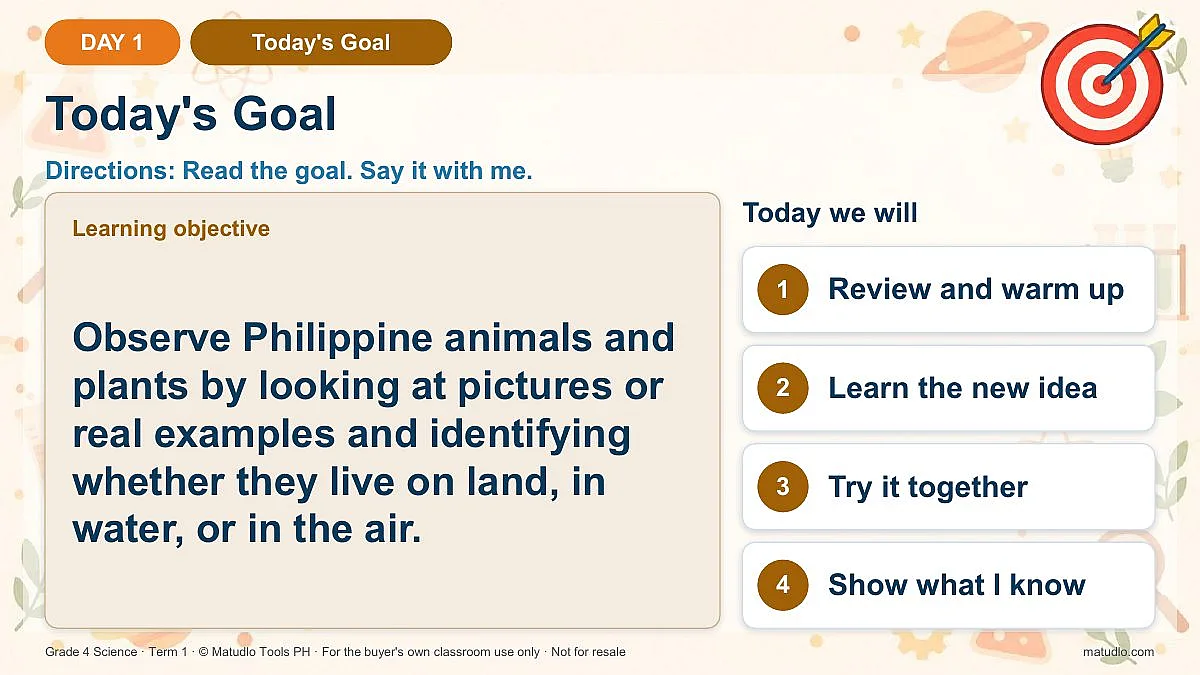
- Day 1 (Mon, Aug 17): Observe Philippine animals and plants by looking at pictures or real examples and identifying whether they live on land, in water, or in the air.
- Day 2 (Tue, Aug 18): Classify terrestrial organisms by grouping Philippine animals (e.g., carabao, dog) and plants (e.g., mango tree, rice) that live on land, using a simple drawing or diagram.
- Day 3 (Wed, Aug 19): Classify aquatic organisms by grouping Philippine animals (e.g., tilapia, bangus) and plants (e.g., water lily, seaweed) that live in water, using a drawing or diagram.
- Day 4 (Thu, Aug 20): Classify aerial organisms by grouping Philippine animals (e.g., maya bird, bat) and plants (e.g., orchids that grow high on trees) that live or thrive in the air, using a drawing or diagram.
Column notes: HOLIDAY. Every plan keeps all five columns (Monday to Friday); tests, holidays and days with no objective in the BCO are marked, not dropped.
Built the way school heads check lesson plans
- Learning competencies and objectives are quoted, not rephrased.
- Each objective is written in CAP format (Condition, Audience, Performance).
- Every day ends with a generalization through guided questions, an application of learning, and an assessment aligned to the objective.
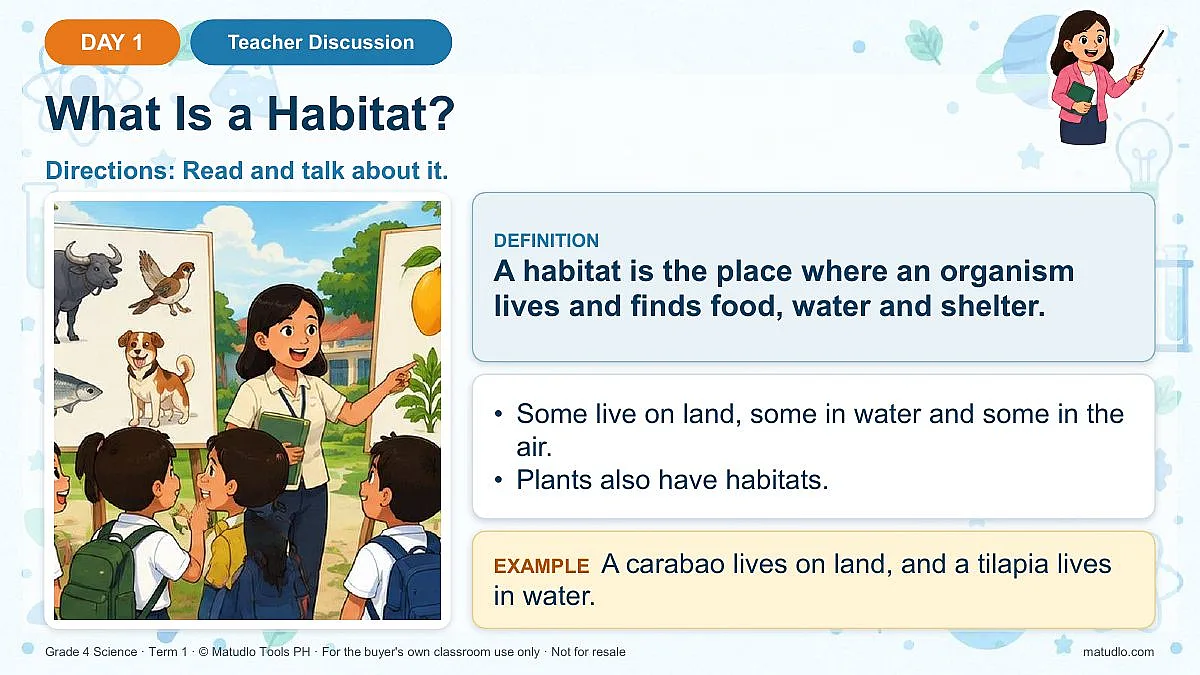
- Each lesson has a Teacher Discussion with a definition, an elaboration and an example, so the slides read like a short lesson, not just a list of tasks.
- Built on the 5E model (Engage, Explore, Explain, Elaborate, Evaluate) with I do, we do, you do guided practice, clear test directions and a scoring guide. Heat, fire and chemicals are teacher demonstrations or picture observations only, never handled by learners.
- Each plan lists free online resources for the teacher (all optional).
Good to know
- Licensed for one teacher's own classroom use. Please do not resell, share or upload the files.
- AI declaration: prepared with the assistance of AI; please review before use. Make your own lesson plans, slides and quizzes with Matudlo AI at matudlo.com.
- Works with Microsoft Word and PowerPoint (or compatible apps). Delivered as one ZIP download.
Customer Reviews
No reviews yet — be the first to share your experience!
Questions & Answers
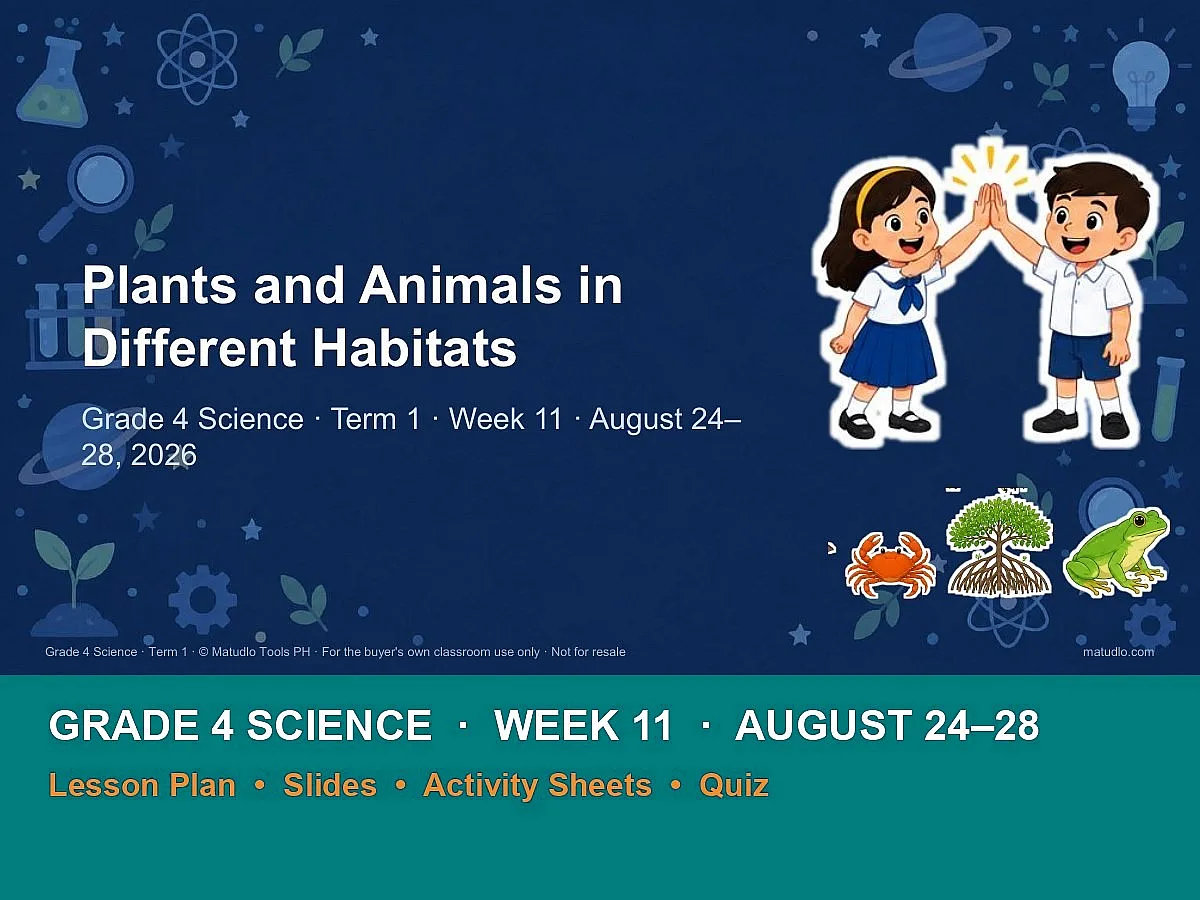
Next week for this class
Ready when you finish this one.
Frequently Bought Together
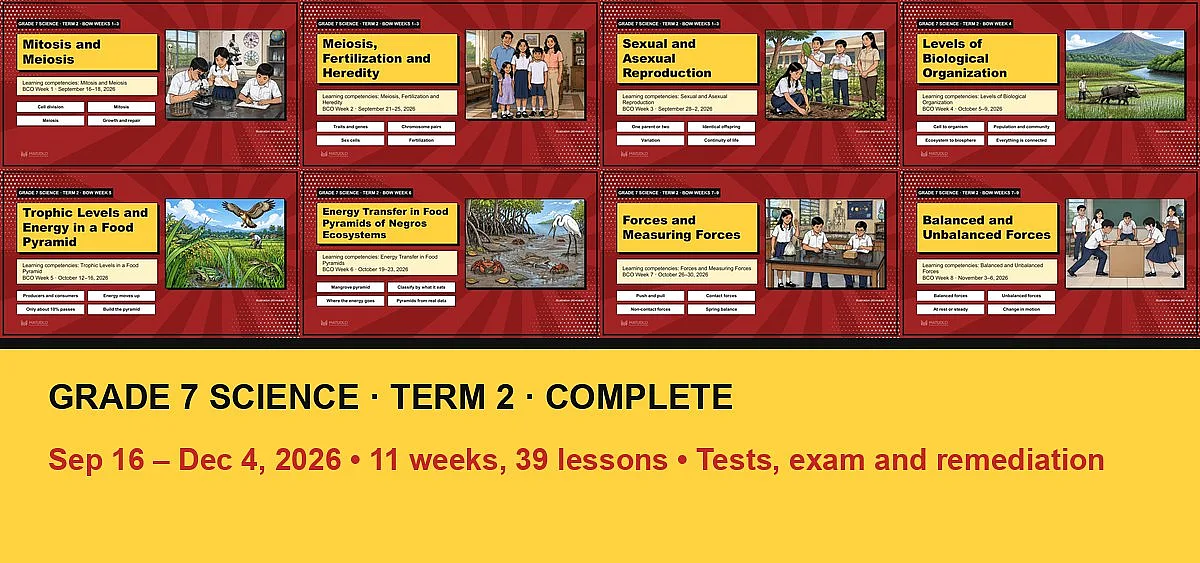
Grade 7 Science Term 2: Complete Bundle (Sep 16 – Dec 4, all 11 weeks + tests, exam and remediation)
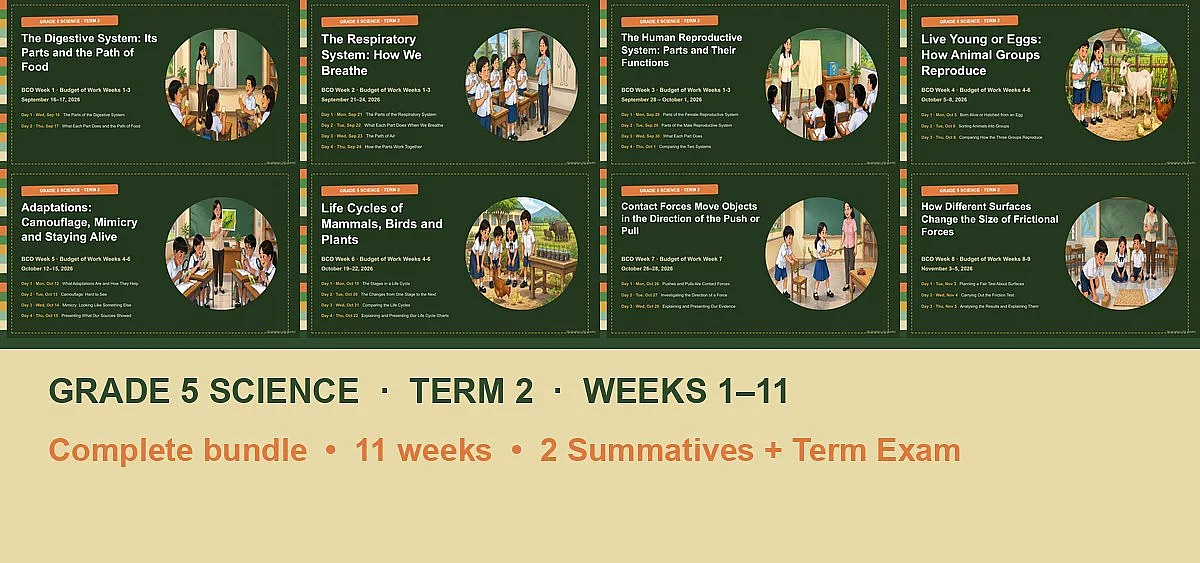
Grade 5 Science Term 2: Complete Bundle (Weeks 1–11, Sep 16 – Nov 26)
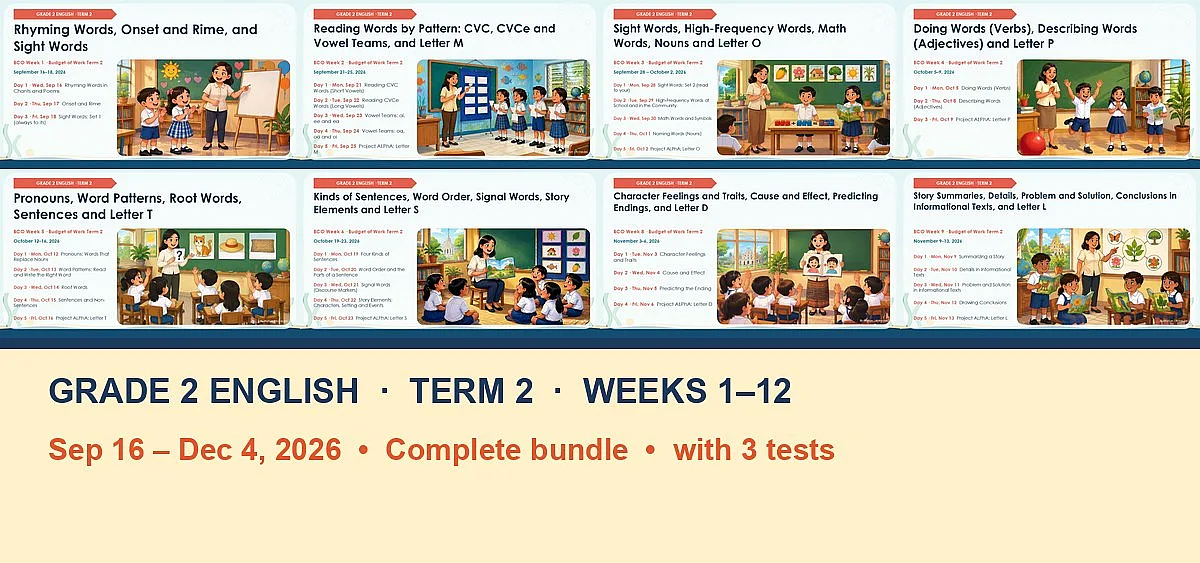
English 2 (Grade 2) Term 2: Complete Bundle (BCO Weeks 1–12, Sep 16 – Dec 4)